
Views: 0 Author: Site Editor Publish Time: 2026-07-15 Origin: Site


The structural integrity and opening mechanics of a custom gift box dictate the baseline of the customer’s unboxing experience and the physical safety of the product. Selecting a box structure based purely on aesthetics often leads to misaligned unit economics, exorbitant freight costs, or catastrophic transit failures. Brands frequently underestimate the hidden costs of assembly time and dimensional weight. You must evaluate how the packaging performs on the fulfillment line and during transit. This guide provides a technical evaluation framework to align product specifications, fulfillment logistics, and brand positioning with the optimal box structure. We cover dimensional constraints, core structural mechanics, interior architecture, and common implementation risks. You will learn exactly how to engineer packaging that protects your products while delivering a memorable unboxing moment without destroying your profit margins.
Structure Dictates Freight and Storage: Pre-assembled rigid boxes offer premium unboxing but require significant warehousing space and incur higher shipping costs compared to flat-pack folding cartons or collapsible magnetic boxes.
Interior Architecture is Non-Negotiable: A high-end exterior structure fails if the interior lacks custom inserts (die-cut foam, molded pulp, or corrugated) to secure the product and create a symmetrical focal point.
Assembly Time Impacts Margins: Complex drawer boxes or multi-piece structures increase fulfillment labor costs; structure selection must account for the brand's packing capabilities.
Prototyping Mitigates Risk: Never scale production without structural sampling, transit drop-testing, and a physical fit-test of all internal components.
Every successful packaging project begins with strict dimensional and logistical parameters. You cannot choose a structure without first understanding the physical demands of your product payload. Packaging engineers look at the raw data of the product before ever considering the visual design. This data-first approach prevents costly redesigns late in the production cycle.
You must calculate the total payload weight to determine the required substrate thickness. Heavy glass jars or liquid-filled cosmetics require a dense 3mm chipboard foundation to prevent the base from bowing when lifted. Lighter apparel items or soft goods can safely utilize a 1.5mm or 2mm board. Assess product fragility to dictate the necessary clearance between the item and the outer box walls. Delicate items need more buffer space to absorb impact energy, while durable goods can sit closer to the perimeter.
Implementing precise dimensional tolerances prevents product damage and frustration. Follow these steps to calculate your internal cavity dimensions:
Measure the absolute maximum length, width, and depth of the product, including any irregular protrusions or caps.
Apply the "Product + Buffer" formula by adding a standard 3 to 5mm (0.125 to 0.2 inches) clearance to the item’s maximum dimensions.
Adjust the buffer based on the insert material; rigid foam requires tighter tolerances than flexible corrugated inserts.
Calculate the exterior dimensions by adding the thickness of the chosen substrate and the insert walls to your internal cavity numbers.
Your warehouse labor costs directly impact packaging viability. You must compare the time-to-pack of different structural designs. A pop-up auto-bottom box assembles in seconds, allowing a single worker to pack hundreds of units per shift. A multi-component rigid box with separate lids, bases, and layered inserts requires careful hand assembly, drastically reducing throughput. Evaluate your daily fulfillment volume to see if manual assembly is sustainable for your operation.
Determine your storage capacity for packaging inventory. Fully assembled boxes consume massive amounts of pallet space. If warehouse real estate is tight, you must prioritize flat-pack or collapsible structures. Storing empty rigid boxes means you are paying to warehouse air, which quickly degrades your operational efficiency.
Identify your primary distribution model before finalizing a design. Direct-to-Consumer (DTC) transit requires robust mailer-style protection to survive parcel networks. The primary packaging must withstand drops, compression, and rough handling. Retail palletized distribution allows for more delicate primary packaging since the master cartons and stretch wrap absorb the transit abuse.
Analyze dimensional weight (DIM weight) pricing from major carriers. Structural bloat drastically increases shipping fees. Carriers charge based on the volume a box occupies, not just its actual weight. Keep the exterior dimensions as tight as possible while maintaining adequate internal crush zones to avoid paying oversized shipping penalties.
Apply the standard packaging budget rule of thumb. Match the cost of the structure proportionally to the retail price of the items. Aim to spend between 5% and 10% of the retail value on the packaging experience. Overspending on packaging for a low-margin item destroys profitability, while underspending on a luxury item damages brand perception.
Design structural compartments to reflect cohesive curated themes. Ensure that mixed-product layouts retain an intentional, uncrowded appearance. A cluttered presentation diminishes the perceived value of the entire package. Use structural dividers to force negative space between items, framing each product individually.
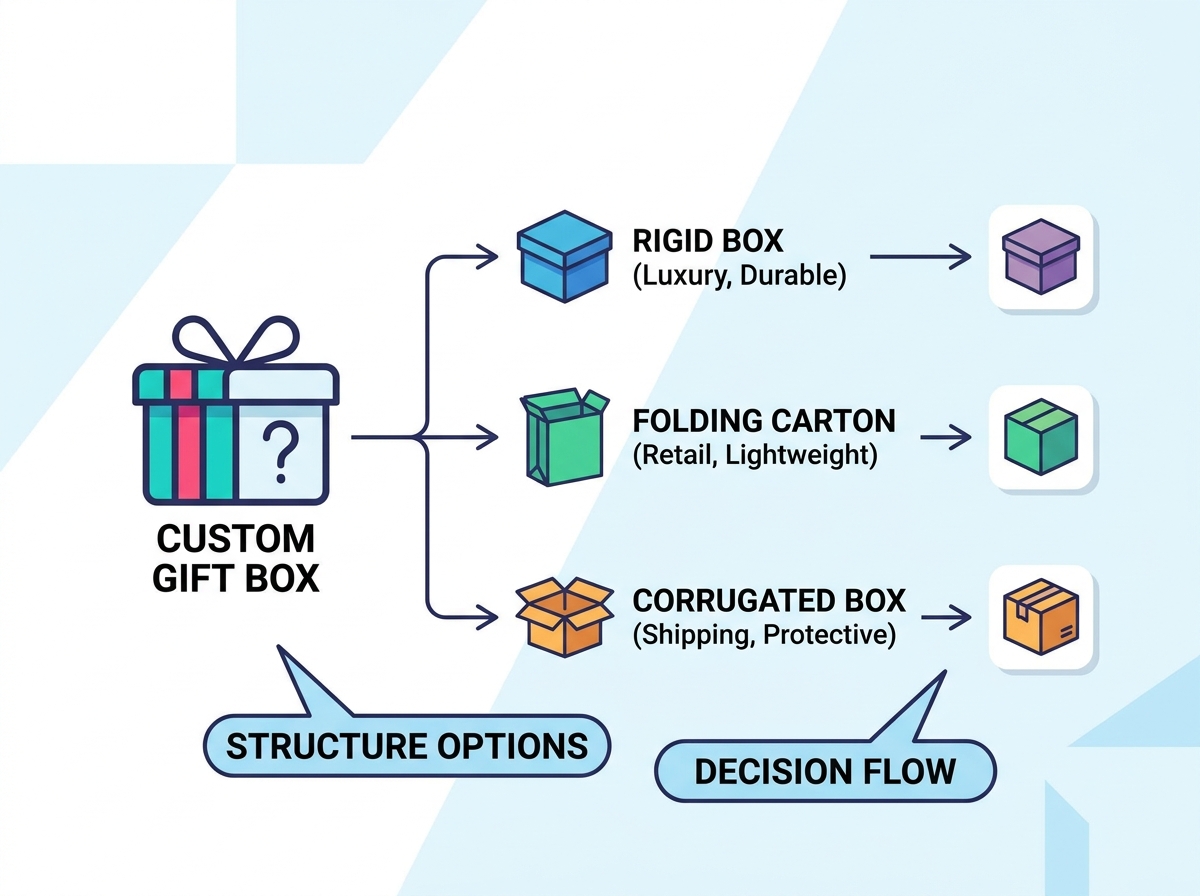
Understanding the mechanical differences between structural styles allows you to match the packaging to your operational constraints. Each option presents distinct advantages and specific trade-offs regarding storage, assembly, and presentation.
These feature a two-piece construction made from thick chipboard wrapped in printed paper. They are best for high-value luxury goods, electronics, and premium cosmetics. They offer the highest perceived value and a classic unboxing feel. The friction fit between the base and lid can be engineered to create a slow, pneumatic release that builds anticipation.
However, they cannot be shipped flat. This maximizes your storage footprint and results in higher inbound freight costs. You must have ample warehouse space to accommodate pallets of empty boxes. The rigid nature also means they offer excellent crush resistance, protecting fragile contents effectively.
This structure utilizes a hinged lid with integrated hidden magnets for a seamless snap closure. They are ideal for corporate gifting, PR kits, and premium subscription programs. The primary advantage is the premium unboxing experience combined with the ability to ship flat. The collapsible design saves warehouse space and reduces inbound freight volume.
The trade-off is that magnetic components complicate end-of-life recycling for the consumer. The magnets must be stripped out before the paperboard can be processed. Additionally, the adhesive strips used to lock the collapsible corners into place during final assembly require extra seconds on the fulfillment line.
A drawer box consists of a tray that slides out from a rigid outer sleeve. They often feature a ribbon pull or a thumb notch for easy access. This style is best for jewelry, confections, and small, dense luxury items. They provide excellent structural rigidity because the sleeve acts as a double wall around the tray.
They require precise manufacturing tolerances to prevent the drawer from sticking or sliding out unintentionally during handling. If the clearance is too tight, changes in humidity can cause the paper to swell, locking the drawer shut. If it is too loose, the tray will fall out when tilted.
These are die-cut from a single sheet of paperboard or corrugated board. They ship flat and fold into shape on the packing line. They are best for e-commerce brands, heavy items, and volume-driven product lines. They are highly cost-effective and scalable with excellent transit durability.
The main drawback is they lack the heavy, premium "thud" of a rigid setup box. However, advancements in printing and finishing allow corrugated mailers to look highly sophisticated. Using an E-flute or F-flute corrugated board provides a smooth printing surface while maintaining structural integrity.
These include multi-piece rigid boxes featuring an exposed inner neck or folder-style assemblies that open like a hardcover book. The shoulder and neck style creates a distinctive gap between the base and lid, often highlighted with a contrasting color. They are best for collector's editions, ultra-luxury product launches, and curated multi-sensory kits.
They offer exceptional branding real estate and a high-end aesthetic. They require specialized production tooling, custom dieline calculations, and higher hand-assembly labor. The complexity of these structures means longer lead times and higher minimum order quantities.
Structure Type | Best Application | Storage Profile | Assembly Speed |
|---|---|---|---|
Rigid Base & Lid | Luxury goods, cosmetics | Fully assembled (High volume) | Fast (Pre-assembled) |
Magnetic Closure | Corporate gifts, PR kits | Collapsible (Flat-pack) | Medium (Requires folding/taping) |
Drawer (Slide) | Jewelry, confections | Fully assembled | Fast (Pre-assembled) |
Corrugated Mailer | E-commerce, heavy items | Flat-pack | Medium (Requires folding) |
Shoulder & Neck | Collector's editions | Fully assembled | Fast (Pre-assembled) |
The exterior structure only does half the work. The interior architecture secures the payload and dictates the visual presentation upon opening. A premium exterior paired with a sloppy interior ruins the customer experience and leads to damaged goods.
Compare your core material options carefully based on the structural demands. Paperboard (like SBS or Kraft) is lightweight and offers high print fidelity for vibrant graphics, making it ideal for folding cartons. Corrugated board features fluted layers for superior impact resistance during parcel shipping. E-flute is the standard for mailers, offering a good balance of strength and printability.
Chipboard provides a dense, rigid foundation necessary for premium paper wraps. It is measured in points or millimeters. A 1.5mm chipboard is standard for small to medium boxes, while 2.5mm to 3mm is required for large or heavy-duty applications to prevent warping.
Evaluate custom die-cut inserts to lock items in place and prevent transit damage. The right insert material depends on the product weight and fragility.
Corrugated Inserts: Cost-effective, highly recyclable, and excellent for heavy items like jars or bottles.
EVA Foam: Offers dense, premium protection for fragile items and electronics. It can be precision-cut and layered with a velvet flocking for a luxury feel.
Molded Pulp: Provides a sustainable, custom-fit cradle. It requires expensive upfront tooling but is highly efficient for large production runs.
Paperboard Partitions: Best for lightweight items, creating simple grids or dividers to keep products separated.
Use structural partitions to create a clear visual hierarchy. Position the main hero product in the optical center. Arrange supporting products symmetrically around the perimeter. Design multi-layered tray structures or paper hinges to build anticipation during the unboxing sequence.
Assess the return on investment for structural enhancements. Soft-touch lamination, spot UV, foil stamping, and embossing elevate the tactile experience. Ensure these finishes do not compromise the structural integrity of the chosen substrate. Heavy embossing on thin paperboard can weaken the fibers and cause tearing at the fold lines.
Integrate functional custom elements to improve usability. Add integrated ribbon pulls for easy tray removal. Design dedicated slots for personalized note cards or instruction manuals. Use customized outer sleeves that double as secondary branding security and tamper evidence, keeping the primary box pristine during transit.
You must balance the aesthetic goals of your custom gift box with the harsh realities of supply chain economics. Ignoring the logistical costs will quickly erode your product margins.
Calculate the landed cost difference between importing pre-assembled rigid boxes versus flat-packed alternatives. Shipping empty rigid boxes means paying to ship air. A standard shipping container might hold 50,000 flat-packed corrugated mailers but only 5,000 fully assembled rigid boxes. Collapsible structures dramatically reduce ocean freight and domestic trucking expenses.
Factor in the cost of warehousing. Pallet storage fees accumulate monthly. If your sales velocity is slow, holding thousands of assembled rigid boxes will drain capital. Flat-pack options allow you to order larger quantities to secure volume discounts without overwhelming your storage capacity.
Analyze upfront costs for custom cutting dies and print plates. Every unique size and shape requires a specific steel-rule die. Digital tooling worksheets help visualize these expenses before committing. Standardizing your box sizes across multiple product lines reduces tooling costs and simplifies inventory management.
Understand how structural complexity drives up minimum order quantities (MOQs). Custom magnetic boxes typically require higher minimums than standard corrugated mailers due to the manual labor involved in assembly. Factories need larger runs to justify setting up the production line for complex, hand-glued structures.
Navigate the trade-offs between luxury finishes and brand sustainability mandates. Luxury finishes often use non-recyclable laminates, metallic foils, or hidden magnets. These elements make the packaging difficult or impossible for the end consumer to recycle through standard municipal streams.
If sustainability is a core brand pillar, you must pivot toward FSC-certified paper, soy-based inks, and mono-material structures. A mono-material design uses only one type of material (e.g., 100% paperboard for both the box and the insert), ensuring the entire package can be tossed into the recycling bin without disassembly.
Packaging projects often fail during the transition from digital design to physical production. Anticipate these risks to protect your timeline and budget. A proactive approach to testing prevents catastrophic failures on the fulfillment line.
Ordering bulk production based solely on digital 3D renders is a critical mistake. Digital models do not account for paper grain direction, adhesive strength, or folding resistance. You must mandate a physical, unprinted structural sample from the manufacturer.
Use this blank dieline sample (often called a white dummy) to test physical product fit, clearance tolerances, and closure security before approving mass production. Insert your actual products into the dummy. Shake it. Turn it upside down. Ensure nothing shifts or falls out.
A beautiful box is useless if it crushes under standard carrier handling. Do not assume a rigid box will survive the parcel network without an outer shipper. Conduct ISTA drop-testing protocols using the exact product payload and interior inserts.
Identify weak points in the corners or lid mechanisms and reinforce the substrate thickness accordingly. If the corners split during a drop test, you may need to upgrade the chipboard thickness or change the wrapping paper to a material with higher tensile strength.
Complex structures requiring hand-assembly at the manufacturing level face extended lead times. Automated folding cartons can be produced in days, while hand-wrapped rigid boxes take weeks. Buffer your inventory planning by four to six weeks for multi-component rigid boxes.
Always account for seasonal production spikes at the factory level. Order your holiday packaging well in advance to avoid expedited shipping fees or stockouts during your busiest sales periods.
The ideal custom gift box structure is not defined by appearance alone. A successful packaging solution must balance product protection, unboxing experience, fulfillment efficiency, storage requirements, shipping costs, and brand positioning.
Rigid boxes deliver a premium tactile experience, magnetic and specialty structures create memorable presentation moments, while folding cartons and corrugated mailers provide greater flexibility for scalable and cost-efficient operations. However, the most expensive structure is not always the best choice. The right solution depends on product weight, fragility, distribution method, production volume, and the customer experience a brand wants to create.
Effective packaging development begins with real product dimensions, physical prototypes, and supply chain considerations—not just digital designs or visual concepts. By evaluating structure, materials, inserts, and logistics together, brands can create packaging that protects products while strengthening perceived value.
A: A rigid box is made from thick, dense chipboard wrapped in paper and cannot be folded flat. It offers a premium feel but requires more storage space. A folding carton is made from thinner paperboard that is die-cut, shipped flat, and folded into shape during assembly, making it highly cost-effective.
A: Only if it is constructed from sturdy corrugated board designed specifically for parcel networks. Rigid setup boxes, magnetic closure boxes, and thin folding cartons require a protective outer master carton to survive the impacts and abrasions of standard shipping.
A: Corrugated mailers and standard folding cartons are the most cost-effective. They require less manual labor to manufacture, ship flat to save on inbound freight, and assemble quickly on the fulfillment line, reducing overall operational costs.
A: You must use custom interior inserts. Die-cut corrugated board, molded pulp, or EVA foam inserts are engineered to the exact dimensions of your products. These inserts lock the items securely in place, preventing shifting and damage during transit.
A: Magnetic boxes require complex manufacturing processes, including embedding hidden magnets into the chipboard and precise hand-gluing of the structural panels. This manual labor necessitates higher production runs for the factory to remain cost-effective.
A: Carriers charge based on the volume a box occupies, not just its actual weight. Choosing an oversized structure increases your dimensional weight, leading to significantly higher shipping fees per unit. You must keep exterior dimensions as tight as possible.


